

Chloe Finlayson · 13 October 2022
A natural way for the UK to play its part in climate change mitigation
The UK was once covered in swathes of woodland and wild land, but natural habitats have been steadily declining. We delve into why this has happened, and how we can fix it.
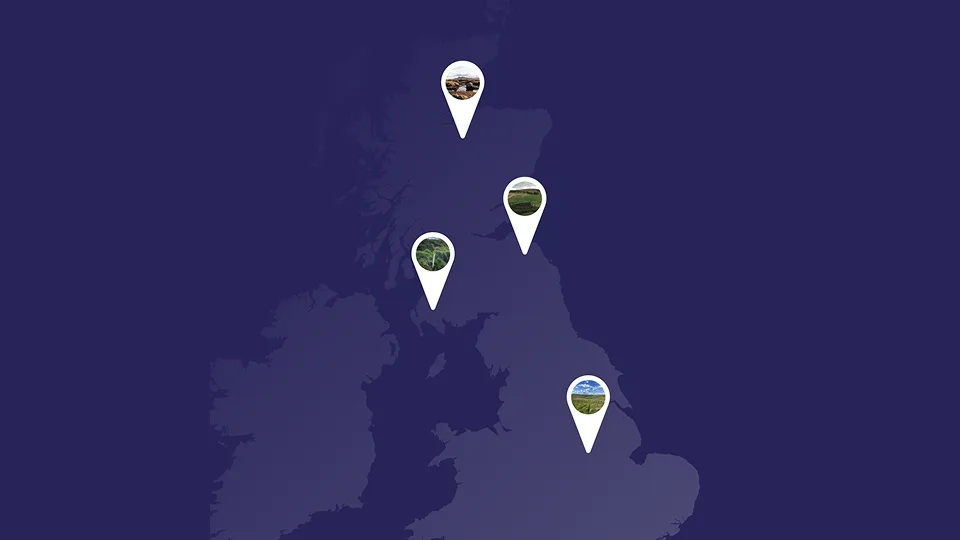
If the UK is going to meet its ambitious climate change targets, we will need to take far better care of our natural resources. In a country that was once covered by huge swathes of forestry and wild land, human activity has steadily encroached on this territory. An asset that provides natural climate change benefits by capturing and storing carbon emissions — carbon sequestration — has been dramatically diminished.
Today, semi-natural habitats — defined as "ecosystems with most of their processes and biodiversity intact, though altered by human activity" — account for just 32.6% of the UK's land area. That includes 13% of land area covered by woodland, and around 12% consisting of peatland, two habitats with huge potential for carbon sequestration. Other natural assets with such potential, including grasslands, fens, and saltmarsh, account for even smaller proportions.
By international comparisons, these numbers are tiny. In France, forestry covers 32% of the land; in Spain, the figure is 37%. And worldwide, the figures are even higher — in around 20 countries, forestry covers more than two-thirds of the land, including developed countries such as Finland, Sweden and Japan.
The decline of the UK's natural habitat
The UK's forestry and woodland has been shrinking since the Middle Ages, but this process accelerated during and after the Industrial Revolution. Industrialisation and urbanisation have also steadily encroached on the country's other natural resources.
This loss of nature has not only reduced the UK's ability to capture and store carbon — so critical in the battle against climate change — but has also had other devastating effects. Research published by the Natural History Museum suggests the UK has led the world in degrading its natural environment, to the extent that just 50% of its biodiversity now remains — a lower figure than in any other G7 nation or major European country. The corresponding figures for Canada and Finland are 89.3% and 88.6% respectively.
Reversing the trend
Now is the time to begin reversing these trends. Not least because the UK has a particular responsibility to use every tool at its disposal to mitigate climate change. The country that brought industrialisation to the world, and the dramatic acceleration of GHG emissions, must now take a lead.
There is some good news. The Climate Change Commission published a landmark study on how the UK could better use land as part of its net zero strategy. Its recommendations include increasing UK forestry cover to 17% by planting 30,000 hectares of woodland each year until 2050, restoring at least 50% of upland peat and 25% of lowland peat, and encouraging low-carbon farming practices and the planting of bioenergy crops.
The Government has responded to these calls, agreeing a target for the UK to reach 30,000 hectares of annual tree planting by the end of the current Parliament, and publishing a plan for peat restoration.
More work to do
Nevertheless, there is plenty of work ahead. The Government published revised data showing that the UK's land-use sector has actually become a net producer of carbon dioxide emissions, rather than acting as a sink. An asset that should be helping the UK combat climate change is actually adding to its carbon footprint.
Government investment alone will not get us to where we need to be — the private sector will have a role to play too. Organisations and individuals have many opportunities to support improved land use, particularly through nature-based carbon offset schemes based in the UK. These projects can make a substantial difference.
Still, we need to make them easier. The current UK offset market involves complex peer-to-peer contracts and lacks a standard legal framework. Poor liquidity and a lack of transparency are also problems. Removing these barriers will be essential to encourage the private sector to do more in this space.